The U.S. power grid is entering the most aggressive investment cycle in its history.
Utilities are gearing up to spend between $1.4 and $1.8 trillion through 2030 to modernize aging infrastructure, harden the grid against extreme weather, integrate renewables, and satisfy an insatiable hunger for power driven by AI data centers, manufacturing, and electrification.
But the industry’s biggest bottleneck isn’t capital, permitting, or supply chains.
The challenge isn’t whether utilities have projects. It’s whether they’ll have the people to build them.
The Real Crisis Isn’t Equipment. It’s Talent.
The conversation around grid modernization usually focuses on the tangible: transformers, substations, transmission lines, and battery banks.
But behind every piece of hardware is a human being responsible for designing, commissioning, maintaining, and operating it. And right now, that human element is stretched to its absolute limit.
This isn’t a temporary hiring crunch; it’s a structural talent shortage driven by two converging forces:
- The Brain Drain: Experienced engineers are retiring at a rapid clip, taking decades of irreplaceable institutional knowledge with them.
- The Talent War: The talent pool hasn’t just shrunk; it has fractured. Utilities are no longer just competing with each other; they are actively losing talent to a massive ecosystem of tech companies, renewable developers, and industrial giants.
The Math Simply Doesn’t Add Up
Consider the sheer volume of monumental shifts utilities are expected to execute simultaneously:
[ Aging Infrastructure Replacement] + [ Grid Resilience & Hardening ]
+
[ Renewable & Storage Integration] + [ AI & Manufacturing Demand ]
=
A massive, unprecedented workload.
Now, map that workload against today’s labor market. Every single transmission project requires a small army of highly specialized professionals: electrical engineers, project managers, relay technicians, commissioning specialists, and field service experts.
These professionals cannot be manufactured overnight. It takes years of hands-on experience to safely and independently manage complex utility assets. When you lack the people, hiring delays today will inevitably become project delays tomorrow.
The Competition Has Changed the Rules
The days of a utility competing solely against the neighboring utility are over. Today, a single protection and control (P&C) engineer might have a half-dozen offers on the table from entirely different sectors:
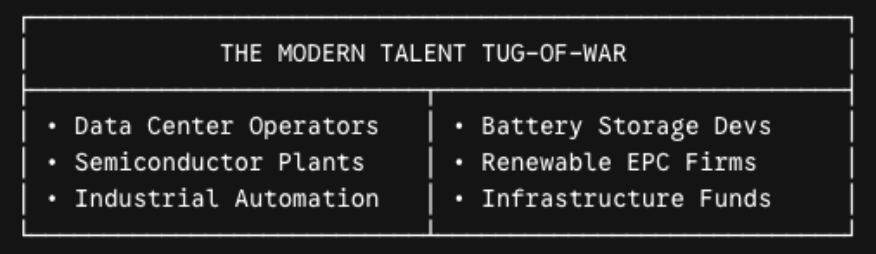
Many of these alternative tech and tech-adjacent firms move faster, interview aggressively, and offer highly flexible, lucrative compensation packages. Utilities relying on traditional, bureaucratic corporate hiring timelines are finding out the hard way that top candidates are off the market before the second-round interview can even be scheduled.
Reliability Depends on People, Not Just Pylons
We frequently hear warnings from grid operators about looming reliability risks as demand outpaces supply. But infrastructure alone won’t keep the lights on if there isn’t a skilled workforce to maintain it.
The New Reality: Talent scarcity is no longer just an HR headache; it is a core operational risk.
- Every delayed hire creates a compounding ripple effect across project timelines.
- Every vacant engineering seat increases the burn-out pressure on existing teams.
- Every retirement without a succession plan widens a dangerous experience gap.
What Forward-Thinking Utilities Are Doing Differently
The industry leaders staying ahead of the curve aren’t waiting for a position to become critically urgent before posting a job description. They treat workforce planning as part of their capital project planning.
They are winning the talent war by:
- Pre-Sourcing Talent: Building robust pipelines months before a project even breaks ground.
- Abandoning Job Boards: Partnering with specialized recruiters who know where passive, high-tier technical talent hides.
- Hiring Proactively: Securing crucial engineering talent when it becomes available, rather than waiting for an empty desk.
- Hiring Trajectory: Looking beyond static resumes to find adaptive professionals who can grow into long-term operational pillars.
The Cost of Waiting
The grid isn’t waiting. AI demand isn’t waiting. And your competition certainly isn’t waiting.
If your workforce strategy isn’t as well-funded, aggressive, and forward-looking as your capital investment strategy, your projects are at risk. Because at the end of the day, a billion-dollar infrastructure program is only as successful as the people delivering it.
How TTG Keeps Your Projects Moving
At Technical Talent Group, we don’t just fill out seats; we secure your project’s timelines. We specialize exclusively in connecting utilities with the specialized engineering and technical professionals required to power the future.
From transmission, distribution, and substation design to controls, commissioning, and emerging battery storage technologies, we know the talent market inside and out. We reach the passive candidates who aren’t looking at job boards but are ready for the right mission-critical opportunity.
Planning your next major cycle? Let’s build your workforce before the schedule forces your hand. Contact TTG Today.