Phoenix IT salary benchmarks matter more than ever in 2026 because technical roles are changing fast. Software development, cloud engineering, cybersecurity, and artificial intelligence are no longer isolated skill sets. They now overlap across product, infrastructure, security, automation, and business operations.
For hiring managers, that creates a real challenge. Salary ranges that worked even one year ago may no longer reflect current market pressure. For candidates, it also creates opportunity. The more clearly you understand the market, the better you can evaluate offers, negotiate compensation, and position your skills.
At Technical Talent Group, we see both sides of the conversation. Employers want strong technical talent without overextending budgets. Candidates want fair pay that reflects their experience, tools, and impact. The answer starts with data.
Phoenix IT Salary Benchmarks for Software Developers
According to Lightcast Q1 2026 data, Software Developers in the Phoenix-Mesa-Chandler market have a median wage of $62.41/hour. Typical compensation ranges from $53.05/hour to $71.77/hour, with a broader annual salary range of $110,340 to $149,284.
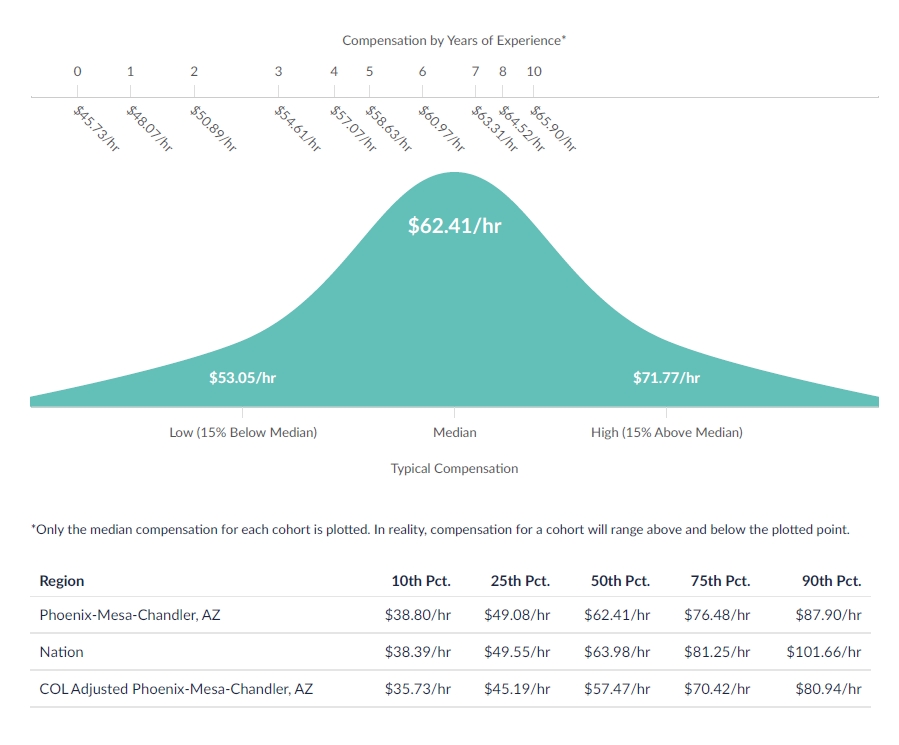
That range tells us two important things.
First, Phoenix is not a bargain market for technical talent. It is a serious technology market with strong compensation expectations. Second, the gap between lower and higher ranges shows how much skills, experience, and specialization matter.
A developer working in a standard application environment may sit at one point in the range. A developer with AI integration, cloud architecture, cybersecurity awareness, automation, or enterprise systems experience may command more.
Nationally, the BLS reports that the median annual wage for software developers was $133,080 in May 2024, which gives hiring teams another useful comparison point when calibrating Phoenix offers.
Why Phoenix IT Salary Benchmarks Are Not Just About Base Pay
Compensation is bigger than base salary.
The Lightcast report shows that when Phoenix’s cost of living is factored in, the software developer median wage of $62.41/hour “feels like” $57.47/hour after cost-of-living adjustment.
That matters for candidates comparing Phoenix offers against remote, hybrid, or out-of-state opportunities. It also matters for employers trying to understand why a technically “competitive” offer may still fall short.
A strong offer should account for:
- Base salary or hourly pay
- Bonus or incentive structure
- Remote or hybrid flexibility
- Benefits quality
- Career development
- Project complexity
- Long-term growth potential
- Speed and clarity of the hiring process
In today’s market, candidates are not only asking, “What does it pay?” They are asking, “Does this role move my career forward?”
Software, Cloud, Cybersecurity, and AI Demand in Phoenix
The Phoenix market is active across multiple technical categories.
Lightcast job posting analytics for January through April 2026 showed 243 unique postings across software developer, cloud, cybersecurity, and artificial intelligence job titles in the Phoenix-Mesa-Chandler region. The same report showed a median advertised salary of $62.15/hour across postings with salary data.
The report also shows strong activity across several job title groups:
- Artificial Intelligence Engineers: 62 unique postings
- Cloud Engineers: 41 unique postings
- Software Developers: 39 unique postings
- Cybersecurity Engineers: 36 unique postings
- Cybersecurity Analysts: 31 unique postings
This does not mean every role is equally easy to fill. It means the Phoenix market is moving across multiple lanes at once. Employers may be hiring for software, but they often need cloud experience. They may be hiring for cybersecurity, but they need automation and scripting. They may be hiring for AI, but they need production-ready engineering judgment.
That overlap is where compensation pressure builds.
Skills That Are Raising the Bar
The most valuable technical candidates are not always the ones with the longest resumes. They are often the ones with the right skill mix.
Lightcast’s Phoenix job posting analytics show that top specialized skills in recent postings include Python, artificial intelligence, computer science, scalability, Amazon Web Services, automation, cybersecurity, workflow management, Kubernetes, and APIs. Python appeared in 44% of matching postings, while artificial intelligence appeared in 42%.
Top software skills included:
- Python
- AWS
- Kubernetes
- APIs
- Microsoft Azure
- Terraform
- SQL
- Java
- Docker
- Go
For employers, this means job descriptions need to be precise. If a role requires cloud infrastructure, AI workflow development, security controls, and backend engineering, the compensation should reflect that complexity.
For candidates, this means skill stacking matters. A software developer who understands cloud deployment, secure architecture, AI integration, and automation can often compete for stronger opportunities than someone with only one narrow technical lane.
Cybersecurity Compensation and Demand Are Still Climbing
Cybersecurity remains one of the most important pressure points in technical hiring.
In a separate Lightcast analysis covering Information Security Analysts, Network and Computer Systems Administrators, and Computer Systems Analysts in Phoenix-Mesa-Chandler, the typical compensation range was $42.07/hour to $56.92/hour, with a median wage of $49.50/hour.
The same report showed 4,504 unique job postings over the last 12 months, which was 18% higher than the national average. It also noted intense employer competition in the region.
National data supports that pressure. The BLS projects employment for Information Security Analysts to grow 29% from 2024 to 2034, much faster than the average for all occupations.
For hiring managers, cybersecurity compensation cannot be treated as a general IT line item. Security talent protects infrastructure, customer trust, compliance, and business continuity. Underpaying these roles can create operational risk.
What Candidates Should Take From Phoenix IT Salary Benchmarks
Candidates should use Phoenix IT salary benchmarks as a guide, not as a script.
Before negotiating, know where you sit in the market. Consider your:
- Years of experience
- Core programming languages
- Cloud platforms
- Cybersecurity exposure
- AI or machine learning experience
- Certifications
- Leadership responsibilities
- Industry experience
- Project complexity
- Ability to work onsite, hybrid, or remote
A candidate with Python, AWS, Kubernetes, AI workflow experience, and strong communication skills may be positioned differently than a candidate with entry-level development experience.
Also, do not rely only on the job title. “Software Developer” can mean many things. It may refer to internal tools, enterprise applications, cloud-native platforms, AI-enabled products, or production systems. The work behind the title should influence the compensation conversation.
Candidates can also review current technical job openings to see how active roles compare with their skills and career goals.
What Hiring Managers Should Take From Phoenix IT Salary Benchmarks
Hiring managers should treat compensation as part of the hiring strategy, not the final step.
If salary is discussed too late, the process slows down. If the range is too low, qualified candidates may never enter the funnel. If the range is unclear, recruiters and hiring teams lose time screening candidates who will not accept the offer.
A stronger hiring process starts with these questions:
- What skills are truly required on day one?
- Which skills can be trained?
- What compensation range reflects the current Phoenix market?
- How fast can we move from interview to offer?
- What does our opportunity offer beyond pay?
- How are competitors positioning similar roles?
This is where contract and contract-to-hire staffing solutions can help employers stay flexible. Not every technical need requires a permanent hire on day one. Sometimes the smarter move is to bring in specialized support for a defined project, evaluate fit, and reduce long-term hiring risk.
Why This Matters for Arizona’s Tech Market
Arizona’s technology ecosystem continues to expand, especially around AI, infrastructure, advanced manufacturing, cybersecurity, and software development. The Arizona Technology Council’s 2026 TechFusion event focused on AI, IT, and computer science as rapidly evolving forces in Arizona’s economy.
That growth creates opportunity, but it also creates pressure.
The BLS projects computer and information technology occupations to grow much faster than the average for all occupations, with about 317,700 openings projected each year across the U.S. from 2024 to 2034.
Phoenix employers are not competing only with local companies. They are also competing with remote-first organizations, national enterprise teams, consulting firms, and fast-scaling technical environments.
That makes current salary data essential.
Final Thought: Better Data Leads to Better Hiring Decisions
Phoenix IT salary benchmarks give both employers and candidates a clearer starting point.
For employers, the goal is not to blindly outbid everyone. The goal is to understand the market, define the role clearly, and build offers that match the level of skill required.
For candidates, the goal is not to chase the highest number without context. The goal is to understand your value, communicate your impact, and choose opportunities that support long-term career growth.
The Phoenix IT market is competitive, but it is also full of opportunity. The teams and professionals who use real data will make better decisions, move faster, and avoid costly mismatches.
For more technical hiring insights or to explore the industries TTG supports, connect with Technical Talent Group.