Phoenix is not becoming an engineering market overnight. It has been building one project, one facility, and one major investment at a time. Semiconductors. Battery storage. Grid modernization. Copper. AI infrastructure. Automation.
Look at those industries individually, and each one creates demand for technical talent. Look at what is happening across Arizona right now, and a bigger workforce story starts to emerge.
Phoenix is sitting at the intersection of some of the most engineering-intensive growth happening in the country.
And the numbers are getting difficult to ignore.
The Investment Is Already Here
Arizona economic development organizations secured 90 competitive projects in 2025, representing more than $34 billion in investment and nearly 28,000 projected new jobs.
Then there is the semiconductor boom.
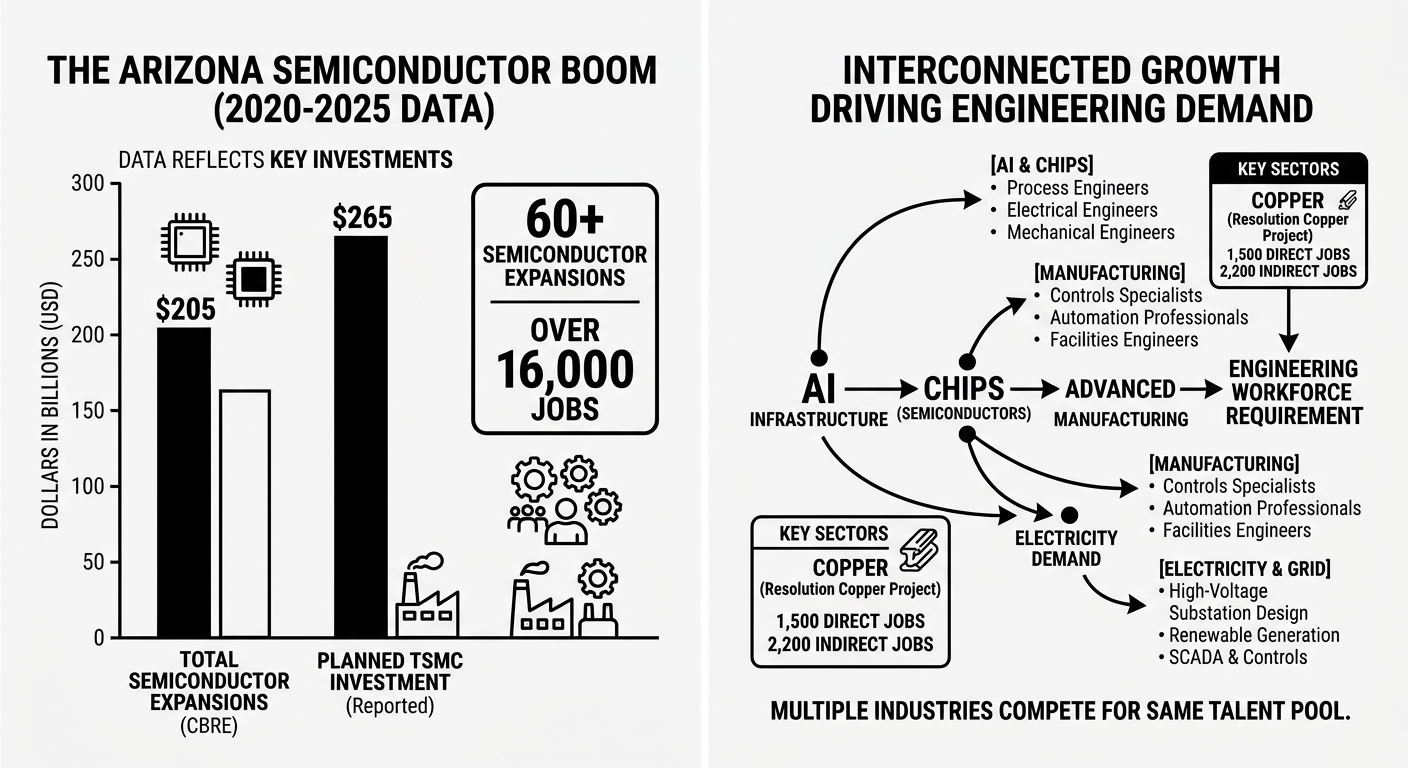
Since 2020, Arizona has landed more than 60 semiconductor expansions representing over 16,000 jobs and $205 billion in capital investment, according to CBRE.
At the center of that growth is TSMC.
What began as a $12 billion commitment to Phoenix has expanded dramatically. TSMC now says its planned Arizona investment totals $265 billion, with plans that include semiconductor fabs, advanced packaging facilities, and an R&D center.
Intel is also investing heavily in Arizona, with $32 billion committed to two new factories. The company reported approximately 9,600 Arizona employees as of January 2025.
That scale of investment does not create demand for one type of engineer.
It creates an ecosystem.
Process engineers. Electrical engineers. Mechanical engineers. Controls specialists. Automation professionals. Construction teams. Facilities engineers. Technicians. Project managers. Skilled trades.
And they are increasingly competing for the same talent pool.
It Is Bigger Than Semiconductors
The engineering story does not stop at the fab.
Arizona’s population growth, manufacturing expansion, data infrastructure, and electrification are putting new pressure on the state’s power system.
That means utilities and engineering firms need talent capable of designing, operating, and modernizing the infrastructure supporting all of it.
Recent Phoenix-area openings have included engineers working on high-voltage substations, renewable generation, SCADA and controls, battery energy storage systems, and grid-scale projects.
One major Arizona project alone is looking to add 2,000 MW of pumped energy storage capacity, requiring expertise across electrical engineering, heavy civil construction, tunneling, hydromechanical systems, geotechnical work, and project delivery.
This is what makes the Phoenix market different.
The industries are not growing independently.
AI needs chips. Chips need advanced manufacturing. Manufacturing needs electricity. Electricity needs generation, storage, transmission, controls, and infrastructure.
Every layer creates another engineering workforce requirement.
And Then There Is Copper
Electrification requires another resource Arizona knows extremely well: copper.
Arizona remains at the center of U.S. copper production, and major projects could add another layer of demand for mining engineers, electrical engineers, mechanical engineers, maintenance professionals, project teams, and skilled trades.
Resolution Copper, for example, completed a major federal permitting milestone in March 2026 and says approximately $500 million in enabling investment is planned over the following two years. If fully operational, the project estimates roughly 1,500 direct jobs and 2,200 indirect jobs.
At the same time, additional copper exploration is moving forward elsewhere in Arizona, including the Copper Creek project near Mammoth.
The connection matters.
The same economy investing heavily in AI, semiconductor manufacturing, battery storage, and grid modernization also needs the materials and infrastructure that make those technologies possible.
The Workforce Numbers Tell the Same Story
Phoenix is not just attracting projects.
It is adding jobs.
The Phoenix-Mesa-Chandler metro had approximately 2.45 million nonfarm payroll jobs in June 2026, up 33,200 from June 2025. Construction employment alone stood at roughly 183,000, while natural resources and mining employment increased 14.6% year over year.
Statewide, Arizona is projected to add another 45,779 jobs between Q2 2025 and Q2 2027, including continued growth in manufacturing and trade, transportation, and utilities.
That creates opportunity.
It also creates competition.
What This Means for Companies Hiring in Arizona
Posting a job and waiting is becoming a risky workforce strategy.
The engineer you need may also be considering opportunities in semiconductors, utilities, renewable energy, advanced manufacturing, mining, automation, or infrastructure.
And the strongest candidates are rarely sitting still.
Companies hiring in Phoenix need to understand the market they are competing in: compensation, candidate availability, relocation expectations, speed-to-hire, and which skills are becoming harder to find.
Workforce planning has to happen before the position becomes urgent.
What This Means for Engineers
For engineers considering Arizona, Phoenix is becoming much more than a relocation option.
It is becoming a place where technical careers can move across industries without necessarily moving across the country.
An electrical engineer can find opportunities in utilities, semiconductor facilities, energy storage, advanced manufacturing, infrastructure, and automation.
A controls engineer can move between industrial automation, renewable generation, manufacturing, and semiconductor environments.
A skilled trades professional can find increasingly complex projects requiring exactly the kind of hands-on technical experience employers are struggling to replicate quickly.
That career optionality is part of what makes the market worth watching.
TTG Has Been Watching This Market Build
At Technical Talent Group, Phoenix is not a market we discovered because it started trending.
It is home.
We work inside Arizona’s engineering and technical talent market while maintaining the national reach needed to find specialized professionals wherever they are.
That matters when the people your company needs are not necessarily applying to jobs — and may not even live in Arizona yet.
As Phoenix continues attracting investment across engineering, manufacturing, energy, technology, mining, and skilled trades, workforce strategy will become an increasingly important competitive advantage.
The projects are already here. The next question is whether the talent will be.
If your Q3 plans include growing an engineering or technical team in Arizona, now is the time to build the workforce strategy behind it.
Talk to TTG about your Q3 hiring needs and the talent it will take to keep your projects moving.