When a new hiring need arises, most companies follow the same playbook.
They open a requisition, begin interviewing candidates, and hire a full-time employee.
For many situations, that’s absolutely the right approach.
However, not every business challenge requires a direct hire solution.
Sometimes the real need isn’t a permanent employee. Instead, it’s getting a project moving, filling a critical skill gap, meeting a launch deadline, or maintaining momentum during a hiring freeze.
Yet many organizations default to direct hiring without asking a simple question:
What outcome are we actually trying to achieve?
The answer often determines whether a direct hire, contractor, or consultant is the smarter business decision.
At Technical Talent Group (TTG), we work with organizations that are growing, transforming, modernizing systems, launching products, and tackling complex technical initiatives. Over the years, we’ve learned that the best workforce strategy depends on the business objective—not the job title.
Here’s a practical framework to help guide the decision.
Direct Hire vs Contractors: Understanding the Real Difference
Direct hire makes the most sense when you’re building capabilities that need to stay within the company for years to come.
In these situations, you’re not simply filling a role. You’re investing in long-term organizational strength.
That may include:
- Building an internal software development team
- Expanding a core department
- Adding leadership talent
- Strengthening institutional knowledge
- Creating succession plans for future growth
As employees become embedded in the organization, they gain a deeper understanding of the business, build cross-functional relationships, and contribute beyond their day-to-day responsibilities.
At the same time, direct hiring comes with challenges.
Recruiting can take months, particularly for highly skilled technical professionals. Internal teams also spend significant time sourcing, interviewing, evaluating, and onboarding candidates.
None of this means organizations should avoid direct hire. Rather, it highlights the importance of treating permanent hiring as a strategic investment instead of a default response.
Where Contract Talent Creates an Advantage
Many leaders still view contract staffing as a temporary fix.
In reality, high-performing organizations often use contract talent strategically because it provides flexibility, speed, and access to specialized expertise exactly when it’s needed.
As a result, contract solutions are often the better fit when the goal is execution rather than long-term workforce expansion.
The Work Has a Defined End Date
Not every initiative requires a permanent employee.
For example, ERP implementations, plant expansions, AI initiatives, cybersecurity assessments, cloud migrations, and controls modernization projects typically have a clear beginning and end.
When that’s the case, hiring someone full-time for six to twelve months of work may not be the most practical solution.
Instead, contract professionals provide the expertise needed to complete the project without creating a long-term staffing commitment.
You’re Operating Under a Hiring Freeze
Hiring freezes create a unique challenge.
While headcount approvals may stop, business priorities often continue moving forward.
Meanwhile, project budgets, transformation initiatives, capital investments, and product development funding may still be available.
Because of this, many organizations turn to contract and consulting solutions during hiring freezes. These arrangements allow critical work to continue without increasing permanent headcount.
You Need Results Quickly
Sometimes speed becomes the most important factor.
If a major project begins next month but a direct hire will take three or four months to secure, waiting may create greater business risk.
Delayed projects can lead to postponed revenue, missed milestones, unhappy customers, and increased pressure on internal teams.
Consequently, engaging contract talent may be the most cost-effective decision, even if the hourly rate appears higher at first glance.
You Need Specialized Expertise
Certain skills deliver tremendous value but are only required for a limited period.
Examples include:
- AI consultants
- Automation specialists
- ERP implementation leaders
- Cloud migration experts
- Senior engineering subject matter experts
- Cybersecurity specialists
Most organizations don’t need these professionals permanently.
Instead, they need them during specific initiatives.
By leveraging contract talent, companies gain access to high-level expertise without carrying those costs long after the project is complete.
Looking Beyond Salary vs Contract Rate
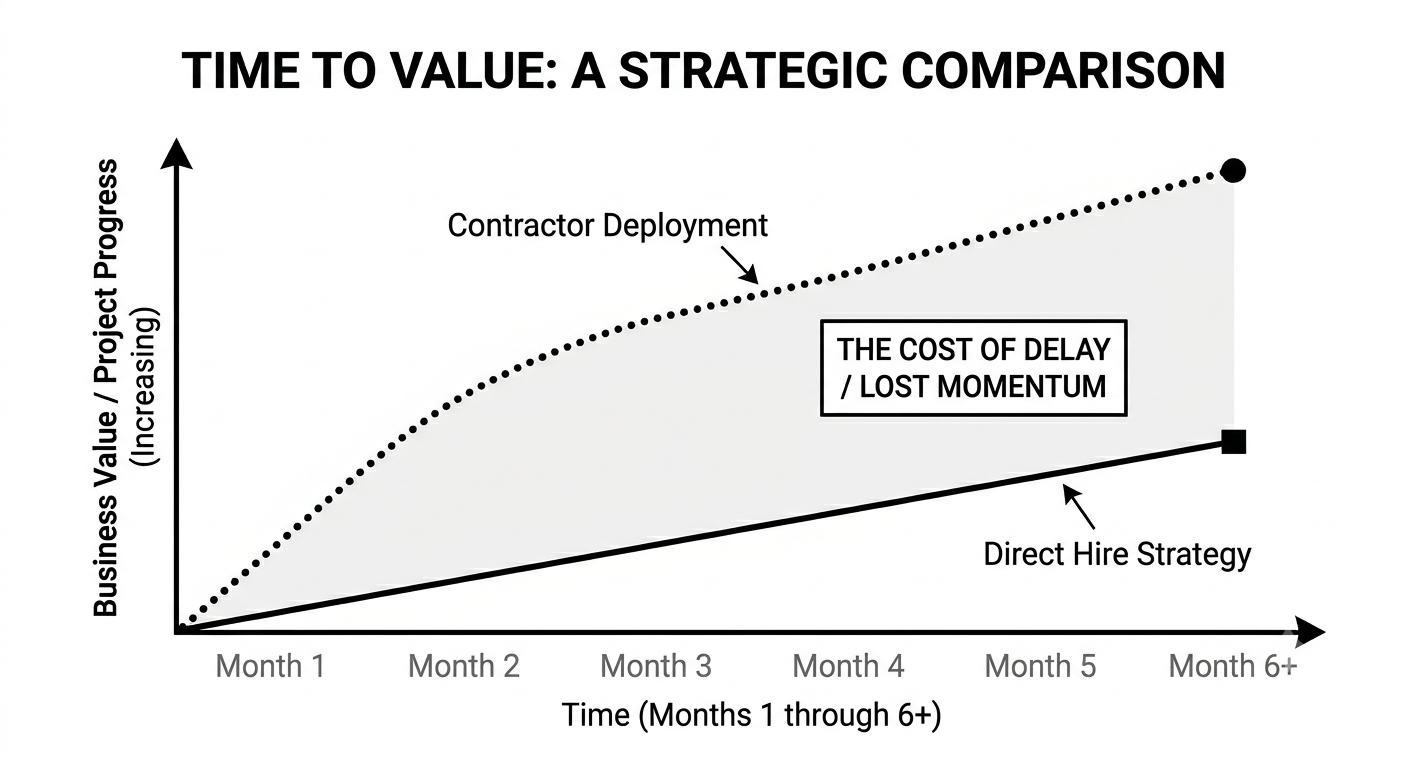
One of the most common mistakes organizations make is comparing a salary directly to a contract rate.
On paper, the contract rate often appears higher.
However, that comparison rarely tells the full story.
A more useful question is:
Consider the impact if a critical project is delayed by three months:
- Does revenue get pushed out?
- Do operational inefficiencies continue?
- Do customer commitments become harder to meet?
- Does team momentum suffer?
- Do strategic initiatives fall behind schedule?
In many cases, the cost of delay far exceeds the difference between a salary and a contractor’s rate.
As a result, the lowest-cost option isn’t always the most economical one.
Why Budget Structure Matters
Another important consideration is where the funding comes from.
Typically, direct hires are funded through headcount plans and operating budgets.
In contrast, contractors and consultants are often funded through project budgets, transformation initiatives, product investments, or capital expenditure programs.
That distinction can significantly influence workforce decisions.
For instance, a company may not have approval for additional headcount while still having available funding for a strategic initiative that must move forward.
Understanding which budget is available often helps clarify the best staffing approach.
A Simple Framework for Making the Decision
When clients ask whether they should pursue a direct hire or contract solution, we start with four key questions.
Is the Need Permanent or Temporary?
When the capability will be needed for years, direct hire is typically the better option.
On the other hand, project-based work often aligns better with contract talent.
How Quickly Does the Work Need to Begin?
If someone needs to contribute within the next 30 days, contract talent usually offers the fastest path.
Conversely, direct hire becomes more practical when the business can comfortably wait several months.
Will This Expertise Be Needed Long-Term?
Long-term capability generally justifies investing in a permanent employee.
However, expertise tied to a specific transformation effort may be better delivered through a contractor or consultant.
What Budget Is Available?
Headcount budgets often point toward direct hiring.
Meanwhile, project, product, transformation, or capital budgets frequently support contract and consulting solutions.
The Best Hiring Decision Starts With the Business Goal
The conversation shouldn’t be direct hire versus contract.
Both approaches have an important place in workforce planning.
The real objective is matching the right talent solution to the business challenge at hand.
Direct hire is often the best choice when building long-term capability and organizational knowledge.
Contract talent, meanwhile, is frequently the better option when speed, flexibility, or specialized expertise are required.
Organizations that consistently execute well understand when to use each approach.
Rather than asking, “What’s our hiring strategy?” they ask:
“What’s the fastest and smartest way to achieve the outcome we’re after?”
That’s where better workforce decisions begin.