The conversation around AI and work tends to jump immediately to one question: Which jobs will AI replace?
The labor market is telling a more complicated story. Right now, the bigger change is happening inside jobs.
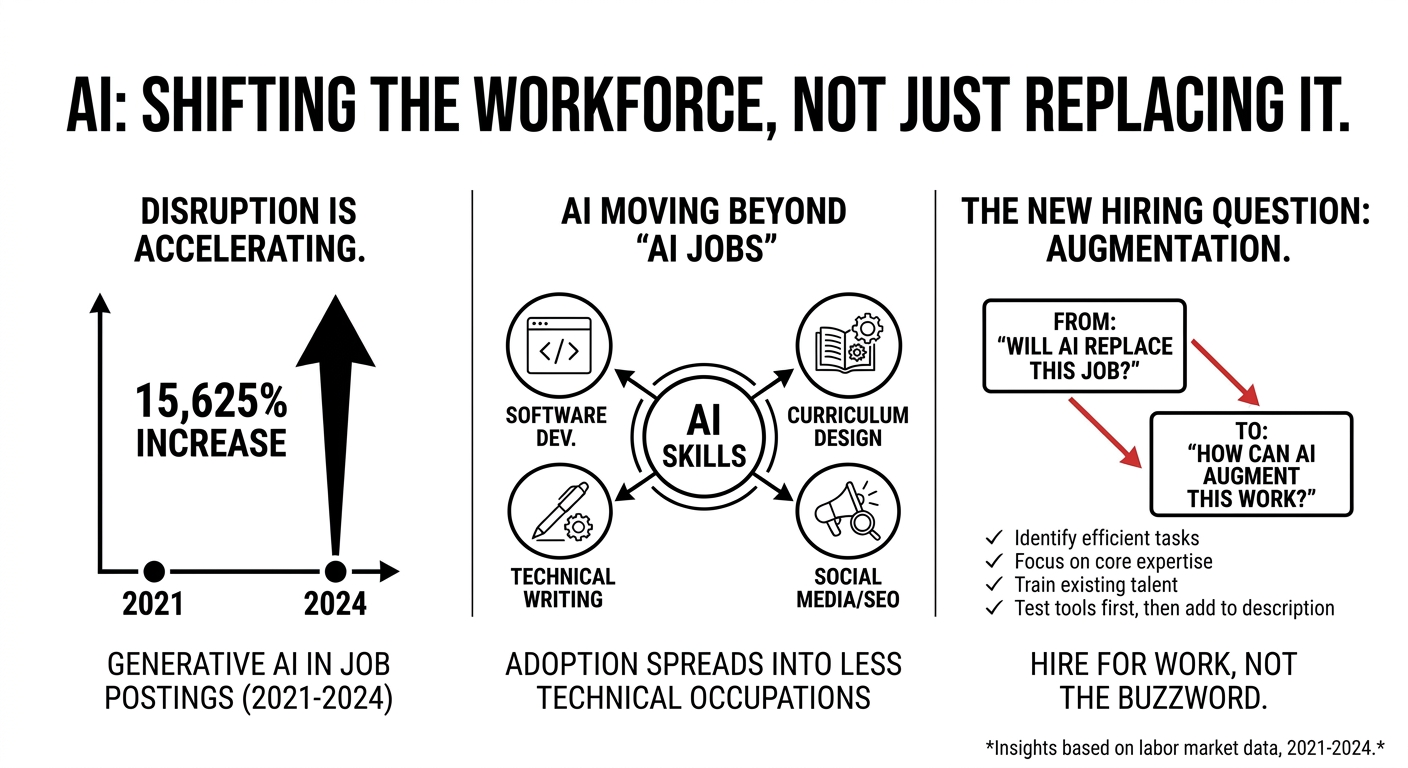
AI is emerging as one of the biggest drivers of skill disruption in the labor market. Job postings referencing generative AI increased 15,625% from 2021 to 2024, more than 156 times as many postings in three years.
AI Skills Are Moving Beyond AI Jobs
AI is changing software development, data science, analytics, and computer science. However, it has not stayed inside the technology department. For example, Lightcast describes generative AI as spreading into less technical occupations including technical writing, curriculum design, digital content production, SEO, and social media.
You may not be hiring an “AI Engineer.” You may still be hiring someone whose ability to work effectively with AI increasingly matters.
Augmentation Changes the Hiring Question
Current labor-market data points toward AI augmenting many jobs rather than simply replacing them, with adoption varying substantially by occupation and industry.
That means employers should ask which AI capabilities actually matter for the job, which tasks could become more efficient, whether the candidate knows when to use the tools, and whether existing employees can be trained instead of adding an entirely new position.
Don’t Add “AI” to Every Job Description Yet
Employers can react to new technology by adding requirements before understanding whether those requirements actually matter. The better approach is to test specific tools and use cases before deciding whether AI capabilities belong in job postings or training programs.
Hire for the work, not the buzzword.
Technical Talent Is Becoming Hybrid Talent
Engineers are still engineers. Project managers still manage projects, and developers still develop. However, the tools surrounding these roles are changing. As a result, employers increasingly need people who can bring strong foundational expertise into evolving work environments.
The strongest candidate may not have every emerging technology already listed on a resume. It may be the person with the technical foundation and learning ability to adopt the next one.
The TTG Take
AI is moving quickly. Hiring strategy should move carefully. At TTG, the goal is not to chase every new keyword appearing in the market. It is to understand which capabilities actually matter to the work our clients need done.
Know what the role requires. Know what can be trained. Know what expertise cannot be compromised.
If AI is changing what your technical team needs, TTG can help you identify and find the talent behind those capabilities.